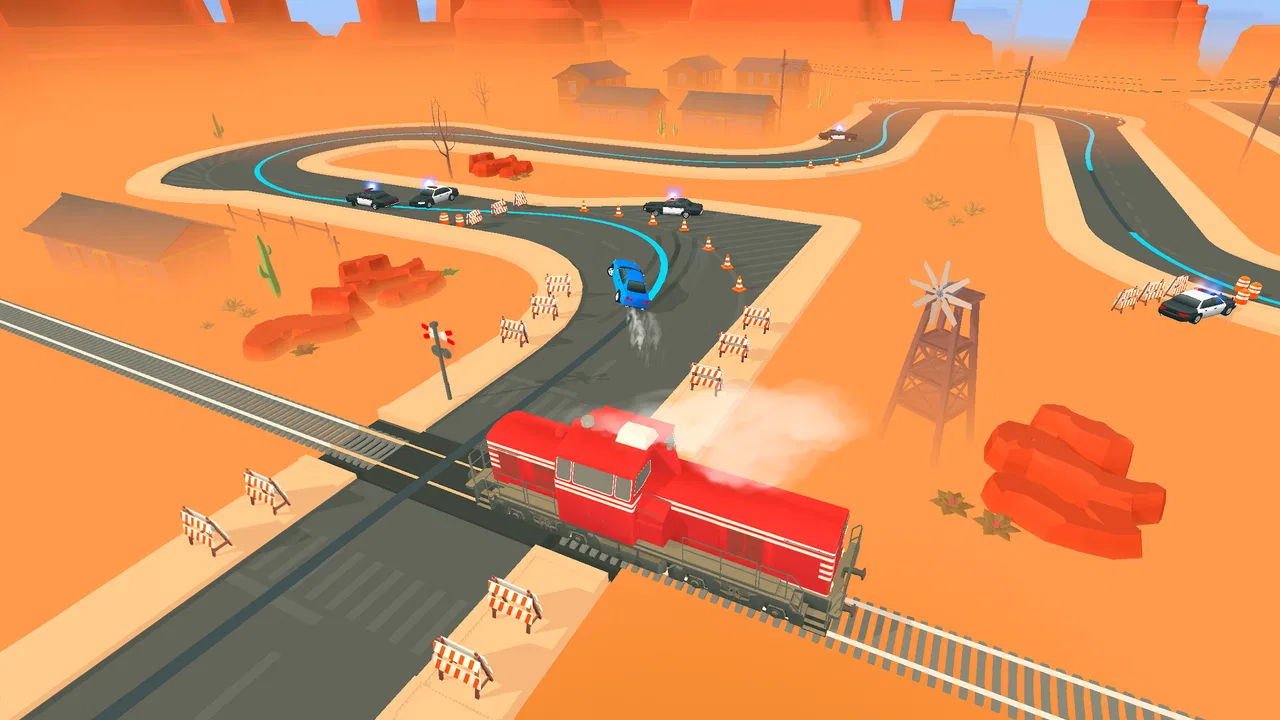
Line Race: Police Pursuit
- 4.6
- Rating
- 50.00M
- Installs
- Free
- Price

 Analysis by App-foxy
I spent time with Line Race: Police Pursuit as a quick-play racing game, and my first impression was that it understands the appeal of a simple control scheme. You are not learning a complicated simulator or tuning a full garage. The attraction is immediate movement: guide the car, drift through turns, avoid losing momentum, and deal with the extra pressure of a police chase. It is the sort of game I can open for a short break without first remembering a long list of controls.
The game comes from CASUAL AZUR GAMES and is free to download, with optional in-app purchases priced at $4.49 per item. Its Everyone age rating makes it approachable for a broad audience, while the racing focus keeps the experience easy to understand even if you normally do not play driving games. After trying it, I would describe it as an arcade racer built around short bursts of concentration rather than a deep motorsport experience.
How the first races create a reason to keep playing
The early appeal comes from the relationship between steering and speed. A straight road is not especially interesting on its own, but a bend changes the decision immediately: do I take the corner safely, or do I push harder and risk a mistake? That small choice gives the opening sessions more purpose than simply holding a direction until the finish.
You May Also Like

 Blood Strike: 2.5 Anniversary
Blood Strike’s Loadouts Turn Every Drop Into a Tactical Gamble
A close look at Blood Strike’s custom loadouts: how fast access to signature weapons reshapes its battle royale rhythm, rewards preparation, and narrows the gap between fights.

 Pandora - Music & Podcasts
Pandora’s Music Is Easy to Start, but Harder to Recover
Pandora’s strength is its low-effort path from a seed to a station. Its weak spot is how much confidence it asks you to place in connection, setup, and quiet recovery.

 8 Ball Pool
 Is Built on Rivalries, Rematches, and Routine
A close look at the rivalries, rematches, shared routines, and unanswered safety questions that turn a quick pool match into a persistent mobile community.

 Samsung Music
’s Quiet Strength Is Playing What You Already Own
Its reach comes less from spectacle than from dependable access to a personal library. That simplicity is both the app’s strongest retention engine and its ceiling.

 AccuWeather: Weather Radar
AccuWeather Review: A Quick, Clear Forecast for Everyday Decisions
For everyday plans, the best forecast is the one you can understand quickly. AccuWeather makes rain timing, radar, and local conditions easy to act on, with a few trade-offs.

 Hill Climb Racing
Why Hill Climb Racing Still Turns Crashes Into One More Run
A tiny car, a bumpy hill and one more upgrade: Hill Climb Racing keeps resurfacing because its simple chaos makes every near-miss feel personal.
More From Our News Desk



The police pursuit adds another layer to those first attempts. Even when the route looks manageable, the chase makes hesitation feel costly. I found myself watching the road more carefully and planning turns earlier instead of reacting at the last instant. That is a useful design choice for a casual racing game because it turns a basic route into a short test of timing.
My advice for a new player is to resist the urge to make every turn dramatic. The fastest-looking line is not always the most reliable one, especially while you are still learning how the car responds. Start by keeping the vehicle under control, then experiment with tighter drifts once the road layout feels familiar. This approach makes the opening feel less random and gives each failed attempt a clear lesson.
The early goals are therefore practical rather than complicated. You are trying to stay on the road, maintain a good rhythm, and finish each run without allowing the chase to overwhelm you. That simplicity is a strength when I want something I can understand within moments. It is less appealing if I am looking for a career mode, detailed vehicle setup, or a large collection of racing disciplines.
What progress feels like during short sessions
One of the more important questions with a compact arcade racer is whether each run feels useful. In this case, progress is felt through improved handling rather than through a large amount of explanation. I began by treating corners as obstacles, but after several attempts I started seeing them as opportunities to preserve speed. That change in approach is the main early reward.
The game’s current version is 2.0.2, and it has reached more than 10 million installs. The strong average rating of 4.7 from roughly 54 thousand ratings suggests that its direct format works for many players. I would not treat popularity as proof that everyone will enjoy it, but it does fit my experience: the basic idea is immediately readable and does not demand a long tutorial before becoming entertaining.
A useful way to judge your own progress is to notice how often you make the same mistake. If you repeatedly drift too early, enter corners too fast, or focus so much on the pursuing police that you miss the road ahead, the problem is usually not a lack of speed. It is a timing issue. I improved more by correcting one habit at a time than by trying to drive aggressively from the beginning.
That makes the game suitable for players who enjoy small, repeatable improvements. A commute break or a few minutes before bed can be enough for several attempts, and the controls do not require the commitment of a longer racing session. The trade-off is that players who need visible long-term milestones may find the experience less satisfying once the basic driving challenge becomes familiar.
Why drifting matters more than simply going fast
Drifting is not just a visual flourish here; it is the main way the game gives the player something active to do. A straight run asks for attention, but a drift asks for judgment. I have to decide when to begin, how much to commit, and when to return to a stable line. That sequence creates a satisfying rhythm when it works and a very clear reason for failure when it does not.
The best practical technique I found was to prepare before the corner rather than trying to save the car halfway through it. Entering with a little control is more valuable than entering at maximum speed and hoping the turn will forgive the mistake. This is especially important during a chase, because a small collision or wide turn can break the flow at exactly the moment when pressure is highest.
I also recommend separating practice from performance. On a familiar route, use one attempt to test how early you can start a drift and another to drive conservatively. Comparing those approaches teaches you whether the risky line genuinely saves time or merely feels faster. That kind of self-imposed experiment is one of the game’s more interesting strengths because it creates depth without needing complicated menus.
However, this focus can become repetitive. If you dislike repeating similar corner decisions, the central mechanic may not hold your attention for long. Players who prefer varied objectives, realistic braking, or detailed car physics will probably be happier with a more traditional racing title. This game is at its best when the pleasure comes from clean movement and quick reaction rather than simulation.
How the difficulty curve affects the pace
The difficulty is most enjoyable when I treat it as a gradual demand for better control. Early runs give me room to understand the relationship between movement and drifting. Later pressure comes from having less tolerance for sloppy decisions, particularly when the police pursuit turns a minor error into a failed attempt. The result is a pace that encourages another try without requiring a long uninterrupted session.
Still, the challenge can feel sharper than expected if you approach every race as a speed test. The game rewards consistency, and that is not always the same as driving aggressively. A player who concentrates only on pushing forward may blame the controls when the real issue is entering turns without a plan. Once I accepted that, the difficulty felt more readable.
For younger players, the Everyone rating makes the game an easy recommendation from an accessibility standpoint, but the chase can still create tension. I would introduce it by showing that losing a run is part of learning the route, not a sign that the game is unfair. For adults, the same pressure works well as a quick mental reset: it is simple enough to start instantly but active enough to prevent passive scrolling.
The minimum operating requirement is Android 7.1, which keeps the game available to many older Android devices. That matters for a casual title because its purpose is often convenience. I would still judge the experience on the actual phone or tablet being used, especially if the player expects very responsive steering. In a game built around narrow timing, any feeling of input delay can be more noticeable than it would be in a slower genre.
Where the chase helps and where it adds pressure
The police element is most effective when it changes how I read the road. Without it, I could treat a corner as a personal best opportunity. With it, I also have to think about survival and avoiding a chain of mistakes. That makes ordinary sections feel more urgent, and it gives the races a stronger identity than a basic line-following challenge.
At the same time, the chase can make experimentation less comfortable. When I am learning a route, I want room to test a turn without immediately feeling punished for it. The game’s quick restart structure helps with that frustration because I can try again soon, but players who prefer relaxed exploration may find the pressure tiring rather than exciting.
My most useful routine was to spend the first attempt observing the route and the second attempt trying to improve one specific corner. I stopped treating every run as a final exam. That changed the mood considerably: the pursuit became a source of information about my mistakes instead of just an enemy closing in. It is a small mental adjustment, but it makes the game more enjoyable for anyone who gets impatient after repeated failures.
The chase also affects who should skip this game. If you want a calm driving app for sightseeing, a realistic racing simulator, or a game where you can freely customize a vehicle, this is not the right fit. If you enjoy compact challenges where a few seconds of better timing can make a run feel completely different, the pursuit gives the format enough tension to work.
Does the progression sustain interest?
My honest verdict is that the progression works best in the short and medium term. The immediate goals are clear, the driving improves through repetition, and the police chase prevents the action from becoming completely passive. I can imagine returning when I have a few minutes and wanting to beat the feeling of a previous run, even without needing a lengthy story or a complicated upgrade plan.
The limitation is that the game’s retention depends heavily on whether I enjoy refining the same core skills. It does not have to be a problem; many excellent arcade games are built around that loop. But it means the audience is specific. Someone searching for a deep racing collection may eventually want more variety, while someone who enjoys quick retries may appreciate the focused design for much longer.
The free entry point makes it easy to test that fit without committing money first. Optional purchases at $4.49 per item are worth considering carefully rather than treating them as necessary. I would play the free experience long enough to decide whether the driving loop itself is enjoyable. If the basic steering, drifting, and chase pressure already feel rewarding, an optional purchase may be easier to evaluate on its own merits; if the core loop feels repetitive, spending will not solve that underlying issue.
There is also a useful distinction between playing for relaxation and playing for mastery. For relaxation, the game may be slightly too demanding because the chase keeps attention high. For mastery, its simplicity is an advantage because I can focus on lines, timing, and consistency instead of managing a large number of systems. That makes it a better companion for short competitive-minded sessions than for long, laid-back drives.
In comparison with usual racing alternatives, this sits closer to an arcade reflex game than to a console-style racer. It is easier to pick up than a simulator and more focused than a game built around collecting and customizing cars. The price of that accessibility is reduced depth outside the central driving challenge. I would choose it when I want immediate action, but I would choose another racing game when progression, vehicle variety, or realistic handling is my main priority.
Overall, I recommend Line Race: Police Pursuit to players who like fast retries, drifting, and the pressure of escaping a pursuit without needing a long setup. Its strongest quality is how quickly it turns a simple route into a timing problem. Its main weakness is equally clear: once that driving loop stops feeling fresh, there may be less to pull in players who need broader variety.
CASUAL AZUR GAMES has kept the concept accessible, and the game’s broad audience is understandable. I enjoyed it most when I played with a specific goal, such as learning one difficult bend or completing a cleaner run, rather than mindlessly repeating races. Play patiently first, then chase speed; that is the approach that reveals its best qualities.
For a free racing game on Android, it is a convincing choice for short sessions and quick skill improvement. I would not present it as a full replacement for a deep racing simulator, but I would recommend giving it a try if you want a compact challenge that combines drifting with pursuit pressure. The result is focused, approachable, and more demanding than its simple presentation initially suggests.
FAQs for Line Race: Police Pursuit
01What is the main objective of Line Race: Police Pursuit?
Line Race: Police Pursuit is a thrilling racing game where players must navigate through challenging courses while avoiding police capture. The main objective is to complete each level by reaching the finish line without being caught by the pursuing police vehicles. Players can utilize various strategies and power-ups to evade capture and achieve higher scores.
02Are there any in-game purchases or ads in Line Race: Police Pursuit?
Yes, Line Race: Police Pursuit includes in-game purchases and ads. Players can choose to buy additional features, upgrades, or remove ads through microtransactions. While ads may appear during gameplay, they can often be removed with a one-time purchase, enhancing the overall gaming experience.
03Is an internet connection required to play Line Race: Police Pursuit?
Line Race: Police Pursuit can be played offline, allowing users to enjoy the game without an internet connection. However, certain features, such as leaderboards and social sharing, may require online access. Additionally, updates and in-game purchases will need an internet connection to be processed.
04What age group is Line Race: Police Pursuit suitable for?
Line Race: Police Pursuit is designed for players aged 12 and up, due to its fast-paced action and mild cartoon violence. Parents should be aware that the game contains ads and in-game purchases, so monitoring spending and screen time is advisable for younger players.
05Can I customize my vehicle in Line Race: Police Pursuit?
Yes, the game offers various customization options for vehicles. Players can modify their cars' appearance and performance by using in-game currency or purchasing upgrades. Customizations enhance both the visual appeal and the strategic capabilities of your vehicle, providing a more personalized gameplay experience.
Pros
- Exciting high-speed chases keep adrenaline high.
- Simple controls make it easy to play for all ages.
- Variety of cars and upgrades enhance gameplay.
- Vibrant graphics create an engaging environment.
- Offline mode available for gameplay without internet.
Cons
- Repetitive levels can become monotonous.
- Ads can be intrusive and disrupt gameplay.
- Limited customization options for vehicles.
- Occasional lag on older devices.
- In-app purchases can be pricey.

Line Race: Police Pursuit
Gallery